
Key Takeaways: More sales activity doesn’t fix performance when the underlying approach hasn’t changed. Many teams respond to missed targets...
3 min read
Key Takeaways:
- More information does not always lead to better execution.
- The real performance gap often appears after training ends.
- Teams may know what to do, but consistency is where results are won or lost.
- AI can accelerate access to ideas, but it does not replace the need for guidance.
- Sustainable improvement depends on turning insight into daily behavior.
We’ve reached a point where almost any answer can be found in seconds. With the rise of AI, even complex ideas can be broken down and delivered almost instantly, so on the surface, it feels like the barrier to improvement should be lower than ever. At the same time, performance does not seem to be advancing at the same pace.
A pattern that comes up often is what happens after training. A team goes through a session, the ideas make sense, and you can see a real shift in execution right away. Questions improve, preparation gets better, and conversations become more intentional. As priorities shift and day-to-day work picks up, those new behaviors need follow-through to stick. Without that, even valuable ideas can fade over time when they are not applied every time.
The Shift from Scarcity to Abundance
Not long ago, information was harder to access, and expertise was often limited to training sessions, coaching conversations, or industry experience. Today, teams can access frameworks, methodologies, and AI-generated guidance on demand, fundamentally changing how organizations learn and operate.
Organizations are generating and consuming more data and insights than ever before and still find it difficult to translate that into measurable performance improvement.¹ The focus has shifted from finding information to filtering it and, more importantly, applying it in a way that changes day-to-day tasks.
Why Information Alone Doesn't Change Performance
One pattern that shows up often is that knowledge tends to accumulate faster than it is implemented. As more ideas compete for attention, it becomes harder to prioritize the things that will create the biggest impact.
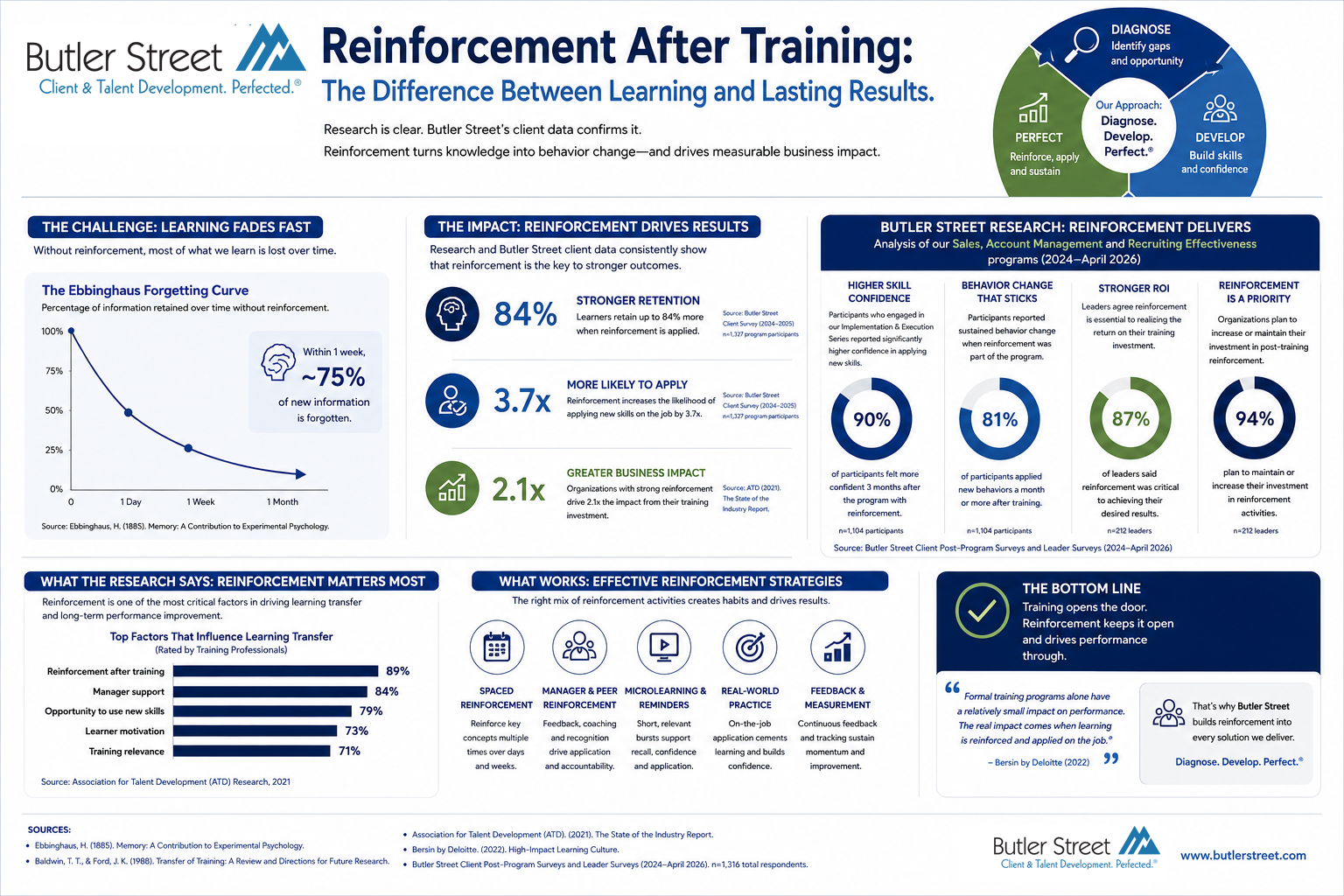
Organizations still find it difficult to turn learning into sustained behavior change and measurable business outcomes despite investing heavily in learning and development.²
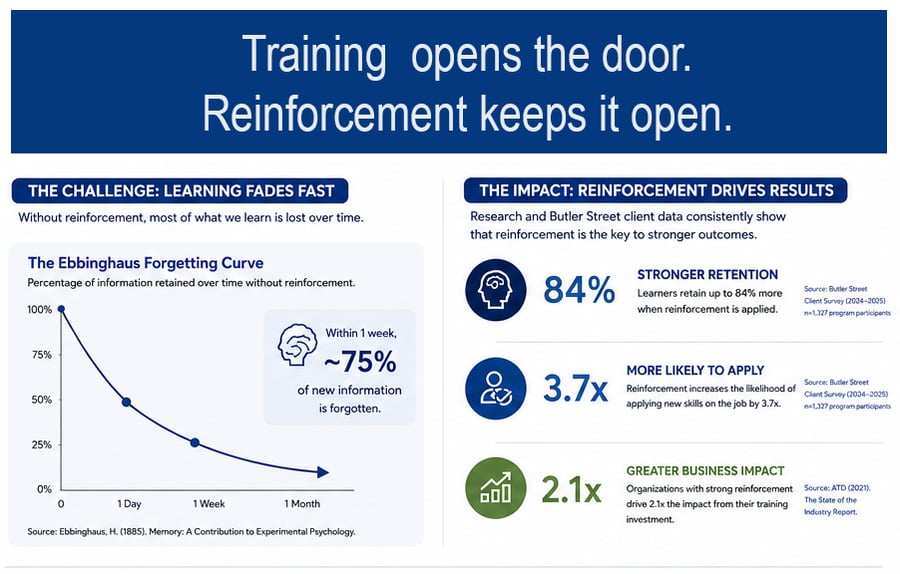
The challenge is not just helping teams learn. It is helping them retain, apply, and sustain the right behaviors over time. Research and Butler Street client data below show why reinforcement is essential to turning learning into measurable performance.
The Role of Guidance in the Gap
If access to information alone were enough, most organizations would already be operating at a much higher level. It must be decided, first, what information is worth applying at all, which is where guidance tends to make the difference.
Guidance creates focus by connecting ideas to specific actions and expectations while reinforcing the behaviors that matter most.
From Knowing to Doing
Teams often know they should be asking better questions during discovery, preparing more effectively for meetings, and being more diligent with follow-up and outreach. The harder part is maintaining focus on those tasks consistently when priorities compete for attention.
Employees who receive ongoing feedback and coaching are more engaged and productive, reinforcing the idea that change depends on ongoing visibility and support rather than knowledge alone.⁴
Where AI Fits and Where It Doesn't
AI is already changing how teams work by helping generate ideas, structure plans, and provide guidance in the moment. Even with that progress, AI on its own does not solve the execution side of performance.
While many organizations are adopting AI tools, achieving meaningful impact still eludes them because those tools are not fully integrated into workflows or tied directly to behavior change.⁵
The real value comes when AI is used as part of a broader system that drives the right behaviors over time.
Turning Information into Performance
At Butler Street, we help organizations turn ideas into consistent execution through coaching, reinforcement, and practical application. That also means integrating tools like AI in a way that supports execution rather than replacing judgment. Our AI Coaches are designed with that in mind. They guide application, strengthen best practices, and support teams in real time as they do the work. When learning is paired with guidance and support, it becomes much more likely to translate into measurable performance.
Access to information is no longer the limiting factor. What matters more is whether teams are applying the right things effectively over time. Learning still plays an important role, especially when it is paired with clear priorities.
If this is something you’re seeing in your organization, let’s connect. We’d be happy to share how Butler Street helps teams turn insight into effective execution.
Citations:
1. McKinsey & Company. (2024). The state of organizations 2024. Retrieved from https://www.mckinsey.com/industries/oil-and-gas/our-insights/the-state-of-energy-organizations-2024
2. Deloitte. (2025). Global human capital trends 2025. Retrieved from https://www.deloitte.com/us/en/services/consulting/articles/human-capital-and-hr-trends-thought-leadership.html
3. Gartner. (2024). Top trends in performance management for 2024. Retrieved from https://www.gartner.com/en/documents/5143531
4. Gallup. (2023). State of the global workplace 2023 report. Retrieved from https://advisor.visualcapitalist.com/wp-content/uploads/2023/06/state-of-the-global-workplace-2023-download.pdf
5. Boston Consulting Group. (2024). AI adoption in 2024: Scaling impact. Retrieved from https://www.bcg.com/press/24october2024-ai-adoption-in-2024-74-of-companies-struggle-to-achieve-and-scale-value